Market Pulse | Issue 04
GEMNYX’s first market indices are now live. They bring three separate Gemfields rough-auction series into a format that is easier to read, explore and trace back to its sources. For gemstone professionals, insurers, investors and institutions, the immediate benefit is practical: a clearer view of how reported auction-average prices have changed within each published series, without having to assemble the history from individual announcements. They measure auction averages, not the entire coloured-stone market.[1]
How to read an index
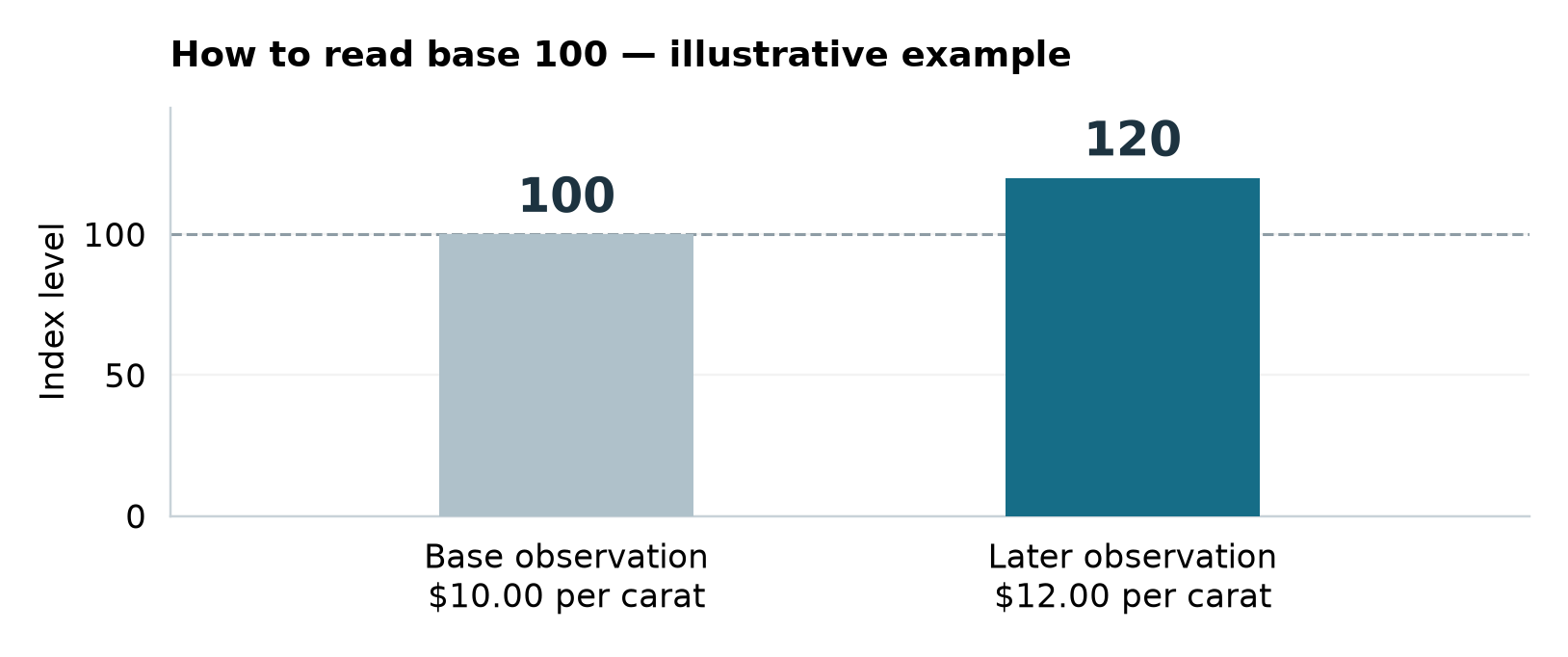
An index starts from a reference observation set to 100. In a fictional example, an average price of $10 per carat at the base date becomes index 100; a later average of $12 per carat becomes index 120. That makes the relative change easier to see. These figures are simply an illustration—not actual auction results or a new GEMNYX series.
The published series have different starting dates and auction categories. Their absolute index levels should therefore not be compared as evidence that one quality category has outperformed another. An index above 200 and an index below 100 describe movements from their own bases, not a like-for-like ranking of gemstone quality or investment performance.[1]
What the three live series show
The Zambia Kagem higher-quality emerald series starts on 1 June 2023, at $165.55 per carat, with a base index of 100. Its latest included observation, 21 May 2026, is $146.08 per carat, or index 88.24. This places the reported auction average below its own starting observation; it does not establish that every comparable emerald has fallen in value.[1]
The separate Zambia commercial-quality emerald series starts on 22 March 2024, at $4.45 per carat. Its latest included observation, 10 September 2026, is $9.72 per carat, or index 218.43. Keeping it separate from the higher-quality series preserves the distinction between the auction categories rather than blending very different material into one headline.[1]
The Mozambique MRM regular mixed-quality ruby series contains 10 included events. Its base is 9 June 2018, at $122.03 per carat and index 100. The latest included event, 20 February 2026, records $279.39 per carat, or index 228.95. GEMNYX also presents a broader, format-separated, source-supported Mozambique history beginning in 2014, covering 21 events. That history is not a complete, continuous ruby or sapphire index.[1]
One boundary deserves particular attention. The October 2026 ruby auction average of $564.54 per carat is outside the existing ruby index. Selected grades had moved to Trade Select, leaving a smaller, higher-grade-heavy offering in October. That changed composition breaks the comparison with the regular mixed-quality series. Treating it as the next comparable point would obscure the change.[1]
Useful evidence, with limits
Auction averages can move because the quality, grade and sold-lot mix change, as well as because buyers pay differently for the material offered. These indices are therefore not constant-quality returns, investment returns or individual gemstone valuations. A rising auction average does not, by itself, establish a matching increase in the value of a polished stone in a dealer’s stock, an insured collection or an institutional holding.[1]
The page helps readers investigate rather than simply accept the headline. Visitors can click index numbers, prices, chart points and dates to inspect dates, USD-per-carat observations, changes versus the prior observation or base, and source links. Historical hover details show exact dates where verified, or month-only dating where that is the supported precision, alongside prices. Data tables provide another way to review the observations.[1]
What comes next
The GEMNYX Consumer Asking-Price Index is in development, initially covering ruby, sapphire and emerald. Its subject will be advertised prices of loose coloured stones, grouped by size, treatment and cut. Faceted stones and individual cabochons will remain separate; pairs and parcels belong in separate research rather than becoming individual-stone constituents.[1]
The aim is repeated, dated, matched retail observations supported by source-coverage checks—not a movement inferred from one catalogue snapshot. Asking prices are offers, not confirmed transactions. No consumer index level or movement has been published, and no launch date is promised. Keeping the auction and retail evidence lanes distinct is central to reading the work responsibly.[1] [2]
A supplier-wide individual price-change monitor is also planned as supporting work, not an available feature. It would record future advertised increases and reductions in each source’s original currency. A listing’s absence would not be treated as proof of a sale.
Disclosure: This is market commentary, not an individual valuation, investment recommendation, price forecast or transaction record. The article does not change GEMNYX-PE-3.0 pricing, valuation or index calculations.
Explore the live market indices, inspect their underlying observations, and visit the Consumer Asking-Price Index in development.
Data courtesy of Gemfields auction results.